

Incident Simulation
Code Red: PHI Exposure Simulation (Healthcare)
This is not a course. This is an incident.
Experience Code Red: PHI Exposure Simulation
SecureStack™ Scenario Preview
This is a Code Red.
Experience how your team detects, investigates, and responds to a real PHI exposure event across Microsoft Defender for Cloud, Sentinel, Purview, Security Copilot, and Copilot in Azure.
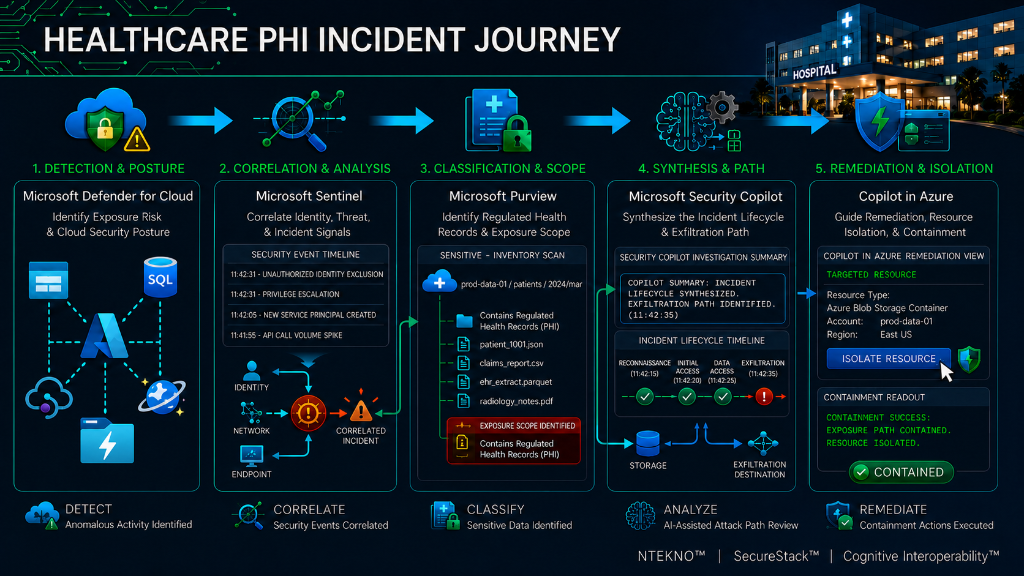
How the Code Red Incident Journey Unfolds
Code Red moves participants through the full incident lifecycle, from cloud posture risk and anomalous activity detection to cross-tool correlation, PHI exposure scoping, AI-assisted investigation, and containment validation across Microsoft security tools.
Who This Program Is For
-
Security engineers accountable for cloud security posture, misconfiguration risk, data protection, and cross-role incident readiness — including those pursuing SC-500 (Microsoft Certified: Cloud and AI Security Engineer Associate)
-
Security operations analysts responsible for threat detection, KQL investigation, and Sentinel incident response — including those holding or pursuing SC-200 (Microsoft Certified: Security Operations Analyst Associate)
-
Information security administrators responsible for sensitive-data governance, classification, and regulatory disclosure decisions — including those holding or pursuing SC-401 (Microsoft Certified: Information Security Administrator Associate)
-
Cloud engineers managing Azure storage, access policies, and misconfiguration risk in healthcare environments
-
Executive stakeholders who need incident visibility and the ability to make defensible decisions under pressure
Where Certification Ends and Operational Readiness Begins
Microsoft security certifications are among the most rigorous and respected credentials in the industry. They establish the tool knowledge, configuration skills, and security principles that every practitioner on this page has invested in developing.
Code Red is the operational layer that follows.
Where certification builds individual tool competency, Code Red builds cross-tool incident judgment — the ability to use Microsoft Defender for Cloud, Microsoft Sentinel, Microsoft Purview, Security Copilot, and Copilot in Azure together, simultaneously, inside a single high-pressure PHI exposure scenario.
Hands-on labs, live investigation, and execution-based response are delivered through SecureStack™ Virtual Instructor-Led (VILT) and Instructor-Led (ILT) engagements.
The Scenario Microsoft Certification Prepares You For — And That Code Red Simulates
Microsoft's certification learning paths develop deep, role-specific expertise across the security stack.
SC-500 develops skills across cloud security controls, storage and data protection, security posture, identity and access, and remediation across cloud environments.
SC-200 develops the skills to investigate, search for, and mitigate threats using Microsoft Sentinel, Microsoft Defender for Cloud, and Microsoft 365 Defender.
SC-401 develops the skills to plan and implement information security of sensitive data using Microsoft Purview and related services.
SC-5006-A — Microsoft's one-day Security Copilot course — develops the skills to use Security Copilot prompts across standalone and embedded experiences. Microsoft Learn's Copilot in Azure module develops foundational skills for AI-assisted operations and resource management in Azure.
Code Red activates all of those skills simultaneously inside a single scenario — PHI already exposed, Sentinel alerts active, Purview scanning, Security Copilot surfacing recommendations, Copilot in Azure ready for remediation input, and compliance leadership asking whether the HIPAA disclosure clock has started.
This is the scenario each certification prepares you to handle. Code Red is where you practice handling it.
How Code Red Activates Your Microsoft Learning Investment
-
AZ-900 (Microsoft Certified: Azure Fundamentals) — Foundational cloud architecture active throughout the simulation
-
SC-500 (Microsoft Certified: Cloud and AI Security Engineer Associate) — Cloud security posture, storage and data protection, security-control validation, and remediation reasoning applied within the Code Red incident scenario
-
SC-200 (Microsoft Certified: Security Operations Analyst Associate) — SOC investigation workflows, KQL analysis, and Sentinel incident triage executed under pressure
-
SC-401 (Microsoft Certified: Information Security Administrator Associate) — PHI classification, data sensitivity governance, and Purview validation as active investigation steps
-
SC-5002 (Microsoft Learn Learning Path) — Defender for Cloud regulatory compliance controls extended into cross-tool, cross-role incident reasoning
-
SC-5006-A (Microsoft Learn Course) — Security Copilot prompt execution used as a live investigation tool inside a real incident narrative
Every certification, learning path, and course you have completed is an active component of the Code Red simulation. The more you bring, the more you execute.
Module Structure
Module 1 — What Code Red Means in Healthcare Cybersecurity
Why PHI exposure is a crisis, not just a technical event. How healthcare breach response differs structurally from every other industry. The roles engaged during a Code Red event and why each carries a different risk frame. How SecureStack™ frames incident response as a coordinated, cross-role effort where no single tool and no single role has the complete picture.
Business Impact: Early misinterpretation or delayed response escalates regulatory, operational, and reputational risk before the first containment decision is made.
Module 2 — Understanding PHI and Where It Lives in Azure
What qualifies as PHI and why it has high financial, regulatory, and operational value to attackers. Where PHI appears across Azure services — Blob Storage, SQL Database, Cosmos DB, App Services, Azure API Management, and Data Lake. How attackers identify high-value PHI fields early in a breach.
Business Impact: Accurately mapping PHI residency determines exposure scope, regulatory notification obligations, and the speed of a defensible response.
Module 3 — How PHI Is Exploited in the Cloud
How storage misconfigurations become PHI exposure vectors. Why bulk access and rapid data retrieval are the earliest behavioral indicators of exfiltration. What the attacker sees in your environment — and why that perspective changes how you investigate.
Business Impact: Recognizing attacker behavior patterns early supports faster, more defensible decision-making before regulatory timelines begin.
Module 4 — SecureStack™: Cognitive Interoperability® in Action
How Microsoft Defender for Cloud, Microsoft Sentinel, Microsoft Purview, Security Copilot, and Copilot in Azure operate together during a real PHI exposure incident. Learners step into a live investigation to detect early exposure risks, correlate attacker activity across identity, storage, and API signals, understand PHI exposure and regulatory impact through Purview, and synthesize cross-tool incident reasoning using Security Copilot.
Business Impact: Cross-tool reasoning prevents premature escalation and produces the audit-ready incident record HIPAA oversight bodies require.
Module 5 — Remediation, Validation, and Operational Readiness
How storage misconfigurations are corrected and validated post-containment. How technical findings translate into governance, legal, and regulatory communication. What operational readiness looks like after a Code Red PHI event and what it takes to sustain it.
Business Impact: Validated remediation protects against repeat incidents and the regulatory audit exposure that follows an unresolved PHI breach.
Module 6 — Code Red Closure, Reporting & Operational Readiness
How the Code Red lifecycle reaches formal closure through final validation, incident closure readiness, compliance confirmation, and executive communication. Microsoft Sentinel confirms that attacker activity has ceased and no new suspicious behavior is detected. Microsoft Purview validates that PHI exposure has been eliminated, data protection controls are functioning, and regulatory requirements are satisfied. Security Copilot generates incident summaries and executive insights that translate root cause, impact, and remediation outcomes into leadership-ready communication. Copilot in Azure supports final operational validation by confirming corrected configurations, secure baselines, and system recovery. Cognitive Interoperability® aligns validation results, compliance evidence, operational readiness, and executive communication into a coordinated closure decision.
Business Impact: Formal closure restores operational confidence, preserves audit-ready evidence, supports transparent incident notification, and proves that PHI exposure risk has been eliminated before the incident is marked resolved.
What You Actually Do in VILT and ILT
You do not watch a demo. You build, trigger, and investigate the incident yourself.
-
Resource Group and Environment Setup — You provision the Azure resource group that serves as your incident environment. Not a pre-built lab. You configure it from the start so you understand the architecture before the breach occurs.
-
Microsoft Defender for Cloud Configuration — You enable and configure Defender for Cloud, establish your security posture baseline, and identify the misconfiguration that becomes the PHI exposure vector.
-
Log Analytics Workspace Setup — You deploy and connect the Log Analytics workspace that receives telemetry from every tool in the stack. Without this, nothing else in the SecureStack™ investigation works — so you understand why centralized telemetry collection matters before you ever run an investigation.
-
Trigger the PHI Exposure Incident — You execute a PowerShell script that simulates attacker behavior: anonymous storage access, bulk file downloads, and rapid data exfiltration across multiple sessions. This is not a "synthetic" scenario. The telemetry and behavioral patterns are authentic to real cloud exfiltration incidents.
-
Investigate Using Microsoft Defender for Cloud — You use Defender for Cloud's native workbooks and recommendations to identify the exact misconfiguration that enabled the breach. You understand not just what was wrong, but why Defender flagged it and what the business risk was before the breach.
-
Build Custom KQL Analytics Rules in Microsoft Sentinel — You write your own detection rule from scratch using Kusto Query Language. You do not use a pre-built query. You understand what log fields matter, why specific thresholds matter, and how to translate attacker behavior into actionable detection logic.
-
Validate Your Detection Rule — You run the rule against the telemetry from the exfiltration you just triggered. Your rule fires correctly. You understand detection confidence and false positive risk in a production setting.
-
Investigate the Incident in Microsoft Sentinel — You use Sentinel's incident interface, investigation graph, and hunting workbooks to correlate storage access, identity activity, and API calls. You build a timeline of attacker activity from first access through data exfiltration.
-
Scan for PHI Using Microsoft Purview — You run a Purview data sensitivity scan against the exposed storage account and storage containers. You interpret the scan results to determine which files contain regulated PHI, what the exposure scope is, and what HIPAA notification obligations trigger.
-
Generate an Incident Narrative Using Security Copilot — You use Security Copilot to synthesize your Sentinel findings into a structured incident narrative: what happened, when, who had access, what data was exposed, and why the misconfiguration happened. Security Copilot is a tool for thinking under pressure — you guide it, you validate its output, and you own the narrative.
-
Validate Remediation and Post-Incident Configuration Using Copilot in Azure — You use Copilot in Azure to confirm that the storage misconfiguration has been corrected, that access policies are now restrictive, and that similar risks have been eliminated. You understand what "fixed" actually means in an Azure security context.
-
Translate Technical Findings Into Executive Communication — You build a summary document that explains the incident, the regulatory implications, the remediation steps taken, and the assurance that PHI exposure risk has been eliminated. This is what leadership reads. This is what regulators see. This is what your organization's defense rests on.
That is Code Red. You do not watch it. You execute it.
Learning Outcomes
Investigate a PHI exposure incident in Azure from first alert through confirmed exposure using real Azure telemetry — not synthetic demos
Implement custom KQL analytics rules in Microsoft Sentinel for both detection (analytics rule) and investigative validation (log query)
Build and configure a SOC alerting pipeline — including the Microsoft Teams SOC channel and Logic App automation — that fires a real-time notification the moment abnormal storage activity is detected
Interpret Microsoft Purview data sensitivity scan results to determine whether exposed files contain regulated PHI and what that means for HIPAA breach notification and OCR disclosure obligations
Use Security Copilot investigation prompts to synthesize cross-tool signals into a structured incident narrative under time pressure
Use Copilot in Azure to validate remediation reasoning, confirm corrective actions, and generate post-incident documentation
Translate technical incident findings into governance-ready and executive-ready communication
Apply Cognitive Interoperability® — structured coordination between human judgment and AI-assisted synthesis — during a live incident scenario
$199 · 6-month Self-Paced access
Upcoming Open-Enrollment Sessions
No upcoming sessions are currently open for individual registration.
Get notified →Duration
Self-Paced · 6-Month Access
Delivery
Self-Paced Online · VILT and ILT engagements
Type
Incident Simulation
Tools Covered
Related SecureStack™ Courses
View All Courses →
AI Security
Securing AI in Healthcare: Prompt Injection to Unauthorized Actions
Instructor-led healthcare AI security training focused on indirect prompt injection, application enforcement, and least-privilege authorization boundaries for AI-enabled workflows.

Incident Simulation
Code Red: Critical Infrastructure Data Exposure Simulation (Energy & Utilities)

Incident Simulation
Code Red: Financial Data Exposure Simulation (Financial Services)
Operational Readiness Starts Here.
SecureStack™ immerses your teams in real-world Microsoft cloud security simulations that strengthen detection, governance, and executive decision-making under pressure.